Showing posts with label Gichin Funakoshi. Show all posts

Thursday, 12 October 2017

Kata Focus - Sochin

Sochin was introduced to Okinawa by Seisho Arakagi based on what he learnt in China from Ru Ru Ko, along with other various Karate and Kobudo Kata. 
This Kata possibly has its origins within the Dragon style of Kung Fu. Sochin bridges the gap between Naha-te and Shuri-te as it originates within the Naha line with Arakaki (Naha master) but the most common versions today are from Shotokan (from Shuri/Tomari). 


Arakagi taught this Kata to Higashionna who in turn taught it to Kenwa Mabuni. 
Mabuni’s style of Shito-Ryu is based on both Naha-te and Shuri-te, as he learnt Karate from both Higashionna and Itosu. 
It is plausible that Gigo Funakoshi learnt Sochin from Mabuni as he was the person who then introduced Soshin into the Shotokan syllabus. 

The Kata utilises the stance Fudo Dachi (which some styles call Sochin Dachi) maintaining a low centre of gravity. This stance is practical/stable and strengthening at the same time, making Fudo Dachi good for both training and bunkai.
Sochin is quite dynamic and rooted in the ground at the same time. Given its various origins and influences Sochin is unlike any other Kata. 

The Meaning of the Kata’s name, ‘Tranquil Force’, can have many different interpretations. The most obvious interpretation is that the name simply refers to the type of techniques used in this Kata. To watch the Kata one might describe the movements as “Tranquil”. Another interpretation might be a description of Sochin’s non-lethal bunkai. As all the bunkai in the Kata would only stop an attacker rather than to permanently injure or kill the opponent (of course this type of non-lethal application of bunkai is not unique Sochin).


Information sources:
https://en.wikipedia.org/wiki/S%C5%8Dchin
http://shotokankaratecsl.com/Kata%2020%20-%20Sochin.html
https://iainabernethy.co.uk/content/sochin-bunkai


Comment below to share any thoughts or opinions you might have. J

Thanks for reading.
Derm
Ͼ


Thursday, 14 September 2017

Warrior Quotes - Part V

Quotes are awesome! They the give us insight into the mind of the masters.

Over the next few weeks I'll be sharing some of my favourite quotes regarding the way of Budo.

If you missed previous week's quotes just click here:
Warrior Quotes - Part I
Warrior Quotes - Part II
Warrior Quotes - Part III
Warrior Quotes - Part IV

Remember - It's best to take your time and try to understand what is really being meant by each quote.


"There are two rules for being successful in Martial Arts.
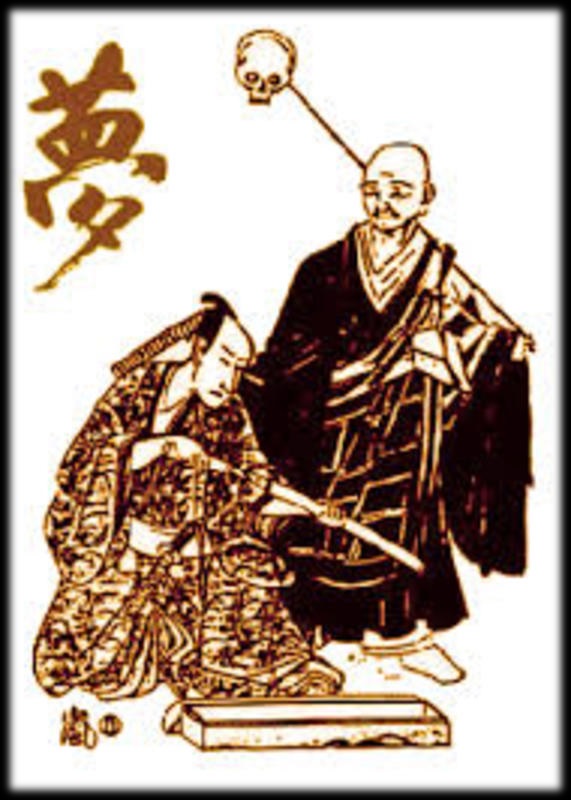
Takuan Sōhō with
Samurai Disciple
Rule 1: Never tell others everything you know."
- Roger H Lincoln


"The art of the sword consists of never being concerned with victory or defeat, with strength or weakness, of not moving one step forward, nor one step backward, or the enemy not seeing me and my not seeing the enemy. Penetrating to that which is fundamental before the separation of heaven and earth where even yin and yang cannot reach, one instantly attains proficiency in the art."
- Takuan Sōhō


"The fastest draw is when the sword never leaves the scabbard. The strongest way to block, is never to provoke a blow. And the cleanest cut is the one withheld."
- Unknown


"When two tigers fight, one is certain to be maimed, and one to die."
- Gichin Funakoshi


"We staunch traditionalists know that appearance is everything. Technique is nowhere near as important as having your pleats straight when you die."
- Steve Gombosi

Kano Jigoro


"The teaching of one virtuous person can influence many; that which has been learned well by one generation can be passed on to a hundred."
- Kano Jigoro


"Meditation is not a means to an end. It is both the means and the end."
- Jiddu Krishnamurti


"A primary aim of Zen is the uncovering of what is known as inherent knowledge. This is not the kind of knowledge that is produced by thinking based on conditioned consciousness. It is said that the ignorant are obstructed by ignorance, while the intellectuals are obstructed by intellectual knowledge. One way of getting past these obstacles and approaching inherent knowledge is to let go of whatever comes to mind."
- Muso Kokushi

Dogen


"Do not follow the ideas of others, but learn to listen to the voice within yourself. Your body and mind will become clear and you will realize the unity of all things."
- Dogen


"If you want the truth to stand clear before you, never be for or against."
- Seng-Ts’an


"Abandoning things is superior, pursuing them is inferior."
- Yen T’ou


"Great faith. Great doubt. Great effort.”
- The three qualities necessary for training


"In the past it was expected that about 3 years were required to learn a single kata, and usually even an expert of considerable skill would only know 3 or at most 5 kata."
- Gichin Funakoshi


Okakura Kakuzo


"Where there is great doubt, there will be great awakening; small doubt, small awakening; no doubt, no awakening."
- Zen saying


"It is not the accumulation of extraneous knowledge, but the realization of the self within, that constitutes true progress."
- Okakura Kakuzo


Comment below to share any thoughts or opinions you might have. J
 
Thanks for reading.
Derm
Ͼ

Thursday, 7 September 2017

Warrior Quotes - Part IV

Quotes are awesome! They the give us insight into the mind of the masters.

Over the next few weeks I'll be sharing some of my favourite quotes regarding the way of Budo.

If you missed previous week's quotes just click here:
Warrior Quotes - Part I
Warrior Quotes - Part II
Warrior Quotes - Part III

Remember - It's best to take your time and try to understand what is really being meant by each quote.

Confucius


"To see what is right and not to do it is cowardice."
- Confucius


"Make yourself a sheep, and the wolf is ready."
Russian Proverb


"A wise man can learn more from a foolish question than a fool can learn from a wise answer."
- Bruce Lee

Laozi


"When you are content to simply be yourself and don't compare or compete, everyone will respect you."
- Laozi


"Do your work, then step back. The only path to serenity."
- Laozi


"We are what we think, all that we are arise with our thoughts. With our thoughts we make the world."
- Buddha


Anko Azato
"The purpose of martial arts is not just to build a strong and healthy body, but also to educate one's mind and forge the spirit. Martial arts seek to build the body, improve one's character and find inner-harmony."
- Anko Azato


"Everything we hear is opinion, not fact.
Everything we see is perspective, not the truth."
- Marcus Aurelius


"The farmer channels water to his land, the Fletcher whittles his arrows, the carpenter turns his wood, and the wise man directs his mind."
- Zen saying


"Resolve to be thyself; and know that he who finds himself loses his misery."
- Zen saying


"Some youthful enthusiasts of karate believe that it can be learned only from instructors in a dojo, but such men are mere technicians, not true karateka.
There is a Buddhist saying that “any place can be a dojo,” and that is a saying that anyone who wants to follow the way of karate must never forget.
Karate-do is not only the acquisition of the art of being a good and honest member of society"
- Gichin Funakoshi.

Baizhang Huaihai


"Your treasure house is within; it contains all you’ll ever need."
- Baizhang Huaihai 


"There is no beginning to practice or end to enlightenment, and there is no beginning to enlightenment or end to practice."
- Dogen


"The believer is happy, the doubter wise."
- Greek proverb


"If you do not get it from yourself, where will you go for it?"
- Zen saying


Comment below to share any thoughts or opinions you might have. J
 
Thanks for reading.
Derm
Ͼ

Thursday, 17 August 2017

Warrior Quotes - Part I

Quotes are great! They are tiny snippets of the master's wisdom, thoughts and ideals.
Sometimes a few words said by the right person in the right way can be immensely influential, even game changing to your Budo journey.

Over the next few weeks I'll be sharing some of my favourite quotes regarding the way of Budo.
Some quotes are simply about Budo training, others are deeper and more philosophical.

Here's a suggestion when reading these:
Try not to just skim over them, it's best to understand what each one is saying. There is so much insight to be gained here if you take your time and seek to understand the point behind the words.
You might have read some or most of these before, that doesn't mean you won't learn something new by reading it again.


"Do not be struck by others, do not strike others. The principle is the peace without incident."
- Chojun Miyagi

Chojun Miyagi


"The ultimate aim of Karate lies not in victory or defeat but in the perfection of the character of its participants."
- Gichin Funakoshi


"Climb the mountain so you can see the world, not so the world can see you."
-Unknown


"The sword has to be more than a simple weapon; it has to be an answer to life's questions."
- Miyamoto Musashi


Miyamoto Musashi


"A black belt is nothing more than a belt that goes around your waist.
Being a black belt is a state of mind and attitude."

- Rick English


"The first five Dan ranks come for what you've gotten out of the system, the next ranks come for what you've given back."
- Unknown


"You may train for a long time, but if you merely move your hands and feet and jump up and down like a puppet, learning Karate is not very different from learning a dance. You will never have reached the heart of the matter; you will have failed to grasp the quintessence of karate-do."
- Gichin Funakoshi

Gichin Funakoshi


"It's not just self defence, it's about...self control, body discipline, and mind discipline...and breath techniques. It involves yoga. It involves meditation. It's an art, not a sport."
- Elvis Presley


"Do not seek to follow in the footsteps of the wise. Seek what they sought."
-Matsuo Basho


Chuang-Tzu

"The perfect man employs his mind as a mirror."
- Chuang-Tzu


"There is nothing either good or bad but thinking makes it so."
- William Shakespeare


"A one sided martial artist is a blind martial artist."
- Unknown


"To win one hundred victories in one hundred battles is not the highest skill. To subdue the enemy without fighting is the highest skill."
- Sun-Tsu


Gogen Yamaguchi


"Five Secrets of Japanese Goju Ryu.
Move quickly.
Sound, calm mind.
Be light in body.
Have a clever mind.
Master the basics."

- Gogen Yamaguchi


"Your goal is not to impress your enemy, but to defeat him."
- Bohdi Sanders


Comment below to share any thoughts or opinions you might have. J
 
Thanks for reading.
Derm
Ͼ


Thursday, 3 August 2017

Anko Itosu's 10 Precepts

Anko Itosu is the most well known student's of Bushi Matsumura.
He had an incredible influence on modern karate. Gichin Funakoshi is most often credited as being the main force behind the popularisation of Karate in modern times, but as Itosu’s student he was really just carrying on what had Itosu started.


Having lived from 1831 to 1915, he lived during a time of great change in Okinawa. He grew up during the last days of the old Ryukyu kingdom and in 1879 is saw his homeland annexed by Japan and reformed into ‘Okinawa Prefecture’. Okinawa suddenly became part of a larger modern world and the locals had to adapt to the modern Japanese way of life.

One of the only photo's of Itosu

The Budo that Itosu learned was somewhat ‘old-school’. It was a practical complete fighting method, intended for the practitioners to learn to be part of the warrior class of a relatively feudal society.

As times were changing, Itosu felt that his Budo needed to change also, if it was to have a place in the modern world.

With this in mind he created new Kata (based on already existing Kata) and also made many changes to existing Kata. The changes he made removed much of the complexity and some of the more violent techniques. The aim of this was to make the art form more ‘palatable’ to a wider demographic, specifically the intention was to make modern Karate suitable for children. 

There is a theory that he had separated the ‘dumbed down’ version of Karate from the real ‘old-school’ Budo and intended to teach both, but the popularisation of the former overshadowed the latter.

Itosu campaigned to have Karate taught at schools, believing that the positive aspects of Karate training being spread to the greater population will be good for society as a whole. He himself taught at the Shuri Jinjo Elementary School in 1901, and then at the First Junior Prefectural High School and at the Okinawa’s Teachers College in 1905.


In 1908 he wrote a letter to both the Ministry or War and Ministry of Education regarding Karate and it's benefits.This letter is one of the few writings on Ryukyu Budo that survived the war and is a valuable part of Ryukyu Budo history.

The following is a translation of that letter:


Karate did not develop from Buddhism or Confucianism. In the past the Shorin-ryu school and the Shorei-ryu school were brought to Okinawa from China . Both of these schools have strong points and I therefore list them below just as they are without embellishment.

1. Karate is not merely practiced for your own benefit; it can be used to protect one's family or master. It is not intended to be used against a single assailant but instead as a way of avoiding injury by using the hands and feet should one by any chance be confronted by a villain or ruffian.

2. The purpose of karate is to make the muscles and bones hard as rock and to use the hands and legs as spears. If children were to begin training naturally in military prowess while in elementary school, then they would be well suited for military service. Remember the words attributed to the Duke of Wellington after he defeated Napoleon, "Today's battle was won on the playing fields of our schools".

3. Karate cannot be quickly learned. Like a slow moving bull, it eventually travels a thousand leagues. If one trains diligently for one or two hours every day, then in three or four years one will see a change in physique. Those who train in this fashion will discover the deeper principles of karate.

4. In karate, training of the hands and feet are important, so you should train thoroughly with a Makiwara. In order to do this, drop your shoulders, open your lungs, muster your strength, grip the floor with your feet, and concentrate your energy into your lower abdomen. Practice using each arm one to two hundred times each day.

5. When you practice the stances of karate, be sure to keep your back straight, lower your shoulders, put strength in your legs, stand firmly, and drop your energy into your lower abdomen.

6. Practice each of the techniques of karate repeatedly. Learn the explanations of every technique well, and decide when and in what manner to apply them when needed. Enter, counter, withdraw is the rule for torite.

7. You must decide if karate is for your health or to aid your duty.

8. When you train, do so as if on the battlefield. Your eyes should glare, shoulders drop, and body harden. You should always train with intensity and spirit as if actually facing the enemy, and in this way you will naturally be ready.

9. If you use up your strength to excess in karate training, this will cause you to lose the energy in your lower abdomen and will be harmful to your body. Your face and eyes will turn red. Be careful to control your training.

10. In the past, many masters of karate have enjoyed long lives. Karate aids in developing the bones and muscles. It helps the digestion as well as the circulation. If karate should be introduced, beginning in the elementary schools, then we will produce many men each capable of defeating ten assailants.

If the students at teacher training college learn karate in accordance with the above precepts and then, after graduation, disseminate this to elementary schools in all regions, within 10 years karate will spread all over Okinawa and to mainland Japan. Karate will therefore make a great contribution to our military. I hope you will seriously consider what I have written here

- Anko Itosu, October 1908


The Original Letter

This particular translation was commissioned by Iain Abernethy, his comments on the translation are as follows:

The translation was taken from scans of Itosu's original handwritten letter. This translation was also done independently by a leading professional translator who is a specialist in this kind of work. The translator was not a martial artist and he therefore had no specific view to promote. I therefore have no reason to doubt its accuracy. That is not to say other translations are necessarily inaccurate - it is certainly similar to others; as you would expect - however, there is no denying that in parts the one I commissioned expresses very different sentiments to some other translations. I would encourage the reader to compare the existing translations and decide for themselves which make most sense and are likely to be the most accurate.
(link to full article below)


Comment below to share any thoughts or opinions you might have. J
 
Thanks for reading.
Derm
Ͼ


Information sources:
https://en.wikipedia.org/wiki/History_of_the_Ryukyu_Islands
https://en.wikipedia.org/wiki/Ank%C5%8D_Itosu
https://www.iainabernethy.co.uk/article/10-precepts-anko-itosu
http://www.karatebyjesse.com/itosu-ten-lessons-of-karate/


Thursday, 4 May 2017

Kata Focus - Seisan

Seisan is the oldest and most widespread Karate Kata. It predates Karate and there is even a theory that it possibly predates eastern martial arts itself. 
Seisan is the only Kata that is prevalent in Shuri-te, Tomari-te and Naha-te.
It can be found in styles including: Shōrin-ryū, Gōjū-ryū, Isshin-ryū, Chitō-ryū, Wadō-ryū, Shitō-ryū, Uechi-ryū, Shotokan, Tang Soo Do, Meibukan, Moo Duk Kwan, Ryū-te, Ryūei-ryū, Seito, Matsumura-ryu, Seibukan, Shōrinji-ryū, Shinki-ryu, Ishimine-Ryu, Koshinkai and Yoshukai Karate.
Almost all versions of this Kata that are now practiced in modern Karate can be traced back to Bushi Matsumura in some way or another.
Being that the Kata is so old, there are many theories regarding Kata’s name and origin. Many people say that the name translates as "13 Hands", "13 Fists", "13 Techniques", "13 Steps" or "13 positions". These are just not true. Seisan is the Okinawan pronunciation of the Chinese word “Shisan” which simply means "13".

The number 13 is a lucky number in Chinese culture. The reason being that digit 1 when positioned in tens sounds like the word 'definite' (shi) in Mandarin and dialects such as Cantonese; while the digit 3 sounds like life, living or birth.
As a result, the number 13, which is pronounced as shisan in Mandarin, can mean 'definitely vibrant' or 'assured growth'.
Within the Kata there are 13 unique techniques and the most common bunkai is defending against 13 different attackers.


Gichin Funakoshi changed the name of most of the kata that he taught. He gave Seisan the name ‘Hangetsu’.
There is a theory about this Kata that it possibly outdates martial arts practice itself. It's thought to have it's origins in having been a sort of a tribal dance relating to the lunar cycles, the tides and months.

This theory might explain the reason for the meaning of the name ‘Hangetsu’ which is ‘Half Moon’. An interesting "coincidence" is that there was apparently a 13 day Luna cycle in their culture at the time. It's possible that this is the origins of the kata, but it's equally as possible that it simply had it origins like any other kata.
Gichin Funakoshi is well known for making changes to Kata techniques and even simplifying them. It's known that he didn’t like this Kata as much as others and so didn't make so many changes. It's possible that it could mean that the Shotokan version of Hangetsu has remained relatively unchanged since the days of Isosu and possibly Matsumura. If this is true, it means the Shotokan version would be one of the oldest versions of Seisan that is practiced today.


(I'd watch this one with the sound turned off.)


Information sources:
https://en.wikipedia.org/wiki/Seisan
http://www.blackbeltwiki.com/seisan
http://www.ikigaiway.com/2012/a-historical-walking-tour-of-seisan-kata/
http://www.wayofleastresistance.net/2008/04/seisan-universal-kata.html
http://ezinearticles.com/?Why-is-the-Number-13-Lucky-to-the-Chinese?&id=1717157


Comment below to share any thoughts or opinions you might have. J

Thanks for reading.
Derm
Ͼ

Thursday, 23 March 2017

"Shu" 守 - The First Step Towards Mastery

守破離
SHU-HA-RI
This is a Japanese term directly meaning “Obey - Digress - Separate” , but (as I described in this post) within the context of Budo it more appropriately means “Follow the rules - Break the rules - Make the rules”, or also could be interpreted to mean “First learn - then detach - then transcend.”

Understanding SHU-HA-RI is understanding the process of mastery.


Today's post is about the first level 'SHU', the stages involved that lead towards the next level 'HA' and how to identify the characteristics of a practitioner in this level.


The Importance of SHU
SHU is by far the most important level. It sets up the foundations of all Budo.
Without going through the stages involved in this level, your Budo will be at least missing something vital and at most pointless and ineffectual.
Many practitioners underestimate the importance of SHU and think that it's ok to skip part or all of it, this never works very effectively.
SHU is easily categorised by having the exact techniques and strict rules to follow, in other words what we generally call "the Style".
In general, a person moves onto the next level (HA) when they begin to question these rules and attempt to understand the reasons for those rules.
A problem can arise when practitioners question the system and they start think that the system and rules aren't necessary. They even think that the system holds people back, so they mistakenly abandon the system/rules and teach beginners with the mindset and attitudes of 'HA', encouraging them to find their own way and not using structured forms. Bruce Lee is a good example of someone who has done this.
The mistake is assuming that the rules hold everyone back. Sticking to the rules only holds back those who have developed beyond the need for them.
Everyone (at the beginning) needs the rules and system in place in order to learn what Budo involves. How can you question the rules if you never learn what those rules are?


The Point is to STUDY & LEARN
It's a part of human nature to 'take the path of least resistance' so therefore be lazy and expect all of the answers will just come automatically.
In reality a practitioner in SHU should be putting effort into learning all the time. Learning is a difficult process and people tend to be naturally resistant to it.
A big step involved in SHU is overcoming this resistance to learning and become adept at open-mindedness with adsorbing new ideas, concepts and techniques.
A good student is practiced at analysing things, thinking things over and over. It becomes second nature to study something (a kata for example), rather than simply having superficial basic knowledge about it.


Stages of SHU
  • Beginner - Knows nothing, the very beginning. 
  • Novice - Only has basic knowledge of the system.
  • Intermediate - Has sound knowledge of most of the system.
  • Advanced - Knows the whole system, some of it very well.
  • Expert - Knows the entire system like the back of their hand (this is the equivalent to somewhere between Shodan and Yondan grade levels).
Once a student is an "expert" and they have sufficient knowledge and experience, they are ready for transition into the 'HA' level. This student is now in a position question their system and begin seeking their 'own way'.


12 signs that you are in (and therefore still need) SHU
Sometimes it can be difficult to judge ourselves in an unbiased way. So it's easy to think we might be at a different stage in our development than we actually are.
The most common misjudgement is believing you've moved on to HA when you're still in 
(and therefore still need) SHU.
Here's 12 signs of a person in SHU:
  1. Require an instructor - If you require someone to teach or coach you in order to develop and grow.
    -
  2. Still learning Kihon - If there are fundamental techniques that you still need to learn or correct.
    -
  3. Don't Know The Whole System - There are still Kata, exercises and patterns within the syllabus of your style that you are still yet to learn.
    -
  4. 'Punches' and 'kicks' - People in SHU commonly refer Karate a 'striking art'. With time and experience we realise that there is a lot more depth regarding the variety of technique applications (any idiot can just punch another person).
    -
  5. Strict Rules - The rules are there to ensure students learn correctly and build strong foundations. A person in SHU needs the rules and should follow them in order to not make silly avoidable mistakes. The rules are there as a framework to follow.
    -
  6. Require Embusen - Similar to the above point about rules. Kata is set up in a specific pattern (embusen) in order to make it easier to remember and also as a structured learning model for those particular techniques.
    -
  7. Putting Value In The Wong Place - The average person in the early years of their Budo career generally places value on the wrong things.
    For example; Tournament medals, grade certificates, fancy belts, fancy uniforms, fancy training locations, looking good in front of others and trying to impress 'Sensei'.
    -
  8. Assuming SHU Is The Whole Journey - Many Budoka would look at the stages listed above (Beginner, Novice, Intermediate, Advanced and Expert) as the whole picture. They fail to realise that this is only the beginning and that HA & Ri make up the majority of the journey. These are the sort of people that quit after grading to black belt, unfortunately many of them will never develop beyond SHU.
    -
  9. Ignorance - Lack of knowledge in general. When there is still much to learn regarding the basic concepts.
    This might seem obvious, but you'd be surprised how many Budoka consider themselves 'advanced' but are truly ignorant, even with basic concepts.
    -
  10. Optional Bunkai - Only a person in SHU isn't absolutely required to know the Bunkai.
    The focus of certain stages within SHU quite often aren't centred around "how to make it work practically", they are more about building strength or learning fundamentals. This isn't the case in every other stage in HA and RI - True Budo is primarily about the Bunkai all the time.
    -
  11. Training or Practical? - Not knowing the distinction between techniques that are designed for a practical purpose and techniques that are designed just for training purposes. You see this when someone attempts to explain a practical application for something that is clearly just a training exercise.
    -
  12. Frustrations - Only a person in SHU should get frustrated with the journey.
    Most of the time frustrations are born of the above mentioned ignorance. A person who still needs to learn the point of Budo training will make the common human mistake of placing blame on others and will act like they're journey is somehow unfair.
    They get upset that 'Sensei' didn't grade them yet - they get upset because 'Sensei' graded someone else - they get upset because they haven't progressed at the rate they expected - they get upset because they're having trouble correcting certain technique - they get upset for not performing well in a tournament - they get upset because their own ignorance is causing them confusion (saying things like "why don't I know that yet?"). All of these frustrations are just immaturity and eventually, when we grow beyond the SHU level, we learn that these trivial concerns are silly and don't have much to do with the overall way of Budo. 


12 signs that you're stuck in SHU
A person might have the knowledge and experience enough begin questioning things and move onto HA, but they choose not to. They seem to be stuck in SHU for some reason. Here's 12 signs that you are stuck in SHU and need to get past before you can truly move to the next level.
  1. Unable To Consider Anything Other Than The System - The belief that other styles and system are incorrect or wrong. Unwilling to be open-minded enough to seek other opinions or options.
    -
  2. Executing Known Kihon In Stages - As a beginner, many of the techniques are taught to us in separate stages so we ensure we're doing them correctly. A person stuck in SHU had be executing their kihon like this for years, they fail to stat making the techniques more natural and practical.
    -
  3. Short-term Mindset - Training for grades, tournament results and other superficial goals.
    -
  4. Sensei Is Always Right - Taking lessons from seniors as absolute truth. When someone is unwilling to be open-minded and seek other opinions or options, they tend to put too much importance on the words of just one person, they don't really think for themselves. "I do it like this because that's what Sensei told me to do, anything else must be wrong."
    -
  5. Questioning is taboo - A Person that is unwilling to move from SHU to HA has come to rely too much on their style and their Sensei. They don't want to know that what they do may not be 'the best style'. They don't want to face the fact the all systems have some inherent flaws and no instructor is perfect. They'd rather not think for themselves and possibly face that. So they're unwilling to question things. It get's the point where questioning things is seen as 'disrespectful' - this is of course stupid.
    -
  6. Animosity towards those who do Question - The sort of person who is unwilling to question things will also try to force this mindset on others (especially lower grades). As time goes on, a culture develops within the class (or even the whole club) of staying ignorant.
    -
  7. Missing the point of SHU - The point of SHU is to provide a foundation for your Budo. SHU is meant to set you up for the HA level. If you're not willing to move onto that level, many of the concepts within SHU have been misunderstood.
    -
  8. Etiquette and Traditions - The majority of traditions are part of the 'rules' of the system and therefore are required for SHU. Those who are stuck in SHU are the type of people that are unwilling to put any thought into the reasons for certain traditions.
    -
  9. Fear of (and a resistance to) Change - New ideas and new ways of looking at things are an essential part of the transition into 'HA'. A person who is unwilling to change their point of view is too reliant on the 'rules' and has trouble dealing with any changes or adaptations to things.
    -
  10. Fear of Responsibility - A key feature of SHU is that a student has a 'safety net' inherent in the system, they can rely on the system to follow and clearly see what is the right and wrong thing to do. Once moving beyond the SHU level a student doesn't have that 'safety net' to rely on, the clear defined rules become 'fuzzy'. They must take responsibility for their Budo. They have to start making their own decisions and find their own way. A person with no confidence in their own abilities will never take the responsibility for their Budo away from the system and will happily stay stuck in SHU.
    -
  11. Complacency - To be happy with their current level of ability and have no need to put any additional effort into further development. This is worse than simply staying within the SHU level, as it also doesn't actually work. You can't just stop developing and stay there if you don't put effort in, you'll go backwards. As Gichin Funakoshi says: "Karate is like boiling water, without heat, it returns to its tepid state."
    -
  12. Oversimplifying Bunkai - I mentioned above that those in SHU think of Karate as a 'striking art'. The person who oversimplifies bunkai is the extension of this mindset and is therefore stuck in SHU. This person only conceives one bunkai for any section of kata. They only think of simple parries and strikes. While we should be careful not to over-complicate the Bunkai, if your bunkai is unimaginative and unrealistic for real life applications it's simply useless. Watch this video and pay attention to both their distancing and the way the attacker uses very rigid attacks and basically gives himself over to be 'defended against'.
In this video's defence it does say that it's "Basic Bunkai", so they're not really saying that an advanced Budoka would use this. The problem is, in my opinion, that these Bunkai don't actually help anything. It's too simple, so much so that nothing in this video has a very high chance of working against a real attack. If anything they give the practitioner a false since of security, assuming they could use this to defend themselves.


This is the first in a series of posts I'm doing regarding SHU-HA-RI. The next post will be all about the next level 'HA' and making your Budo your own.
So stay tuned.

Comment below to share any thoughts or opinions you might have. J


Thanks for reading.
Derm
Ͼ

Thursday, 16 February 2017

文武両道 - Traditional Budo

Terms like 'traditional', 'old-school', 'real', 'authentic', 'pure', 'ancient', 'old-style' and 'original' are thrown around a lot by martial arts clubs these days, especially in marketing for the recruitment of new students.
These terms are used to give the layperson an impression that their club teaches some untarnished pure original style that "Joe Smith" down the road won't teach you. Because of this overuse in marketing, words like these have become almost meaningless.

In reality there is no 'one traditional original source' for martial arts that one person might know that others wouldn't know. Karate itself can be traced to many more than 10 or even 20 original sources, spanning over many decades. 
So if you say that you practice the 'more traditional' form (just because it's different the other place down the road) mean's you're either ignorant, misinformed or simply lying.

Through my own experience and research I have seen firsthand many techniques, customs and forms of etiquette which are called 'traditions' but they couldn't be more than 30 or 40 years old. If it was devised within our lifetime, it's NOT an 'ancient tradition'.
A perfect example of this is a couple of things that we think of as quintessential traditions of karate; the grade ranking system, coloured obi (belts), and the do-gi (karate uniform). Each of these things were come up with in the early to mid 20th century, not hundreds or thousands of years ago as many assume.

So the things that the majority think of as 'old-style traditional Karate' isn't really that old and while many practices have become traditions today, they simply haven't been that way for very long. So they aren't as traditional as we would want to think.

With this in mind, how do you find out what actually is the older martial arts what they might have done in pre-modern times?
How do you learn the 'old-school' system that isn't only 30 or 40 years old?
How do we find what Karate was intended to be, before it was modernised.

The answer is simple in my opinion.

There are no 'traditional styles'!

It's not about finding the style or the club that does it the old-school way, because every Budo school around today, that I have seen, has been influenced in some way by recent modern traditions. 
So in reality 'traditional budo' is really found in a couple of things:

1. It's about YOUR approach to the training.
It's not found in traditions or uniforms. It's about your mindset, what you think of your own training and how you approach it. 
It's about how dedicated you are. Do you take it seriously? Do you think on lessons you should be learning (even meditate on something you need to learn)?

2. Use common sense.
If you're training solely for an upcoming tournament or worrying if your technique looks good, you probably don't have the same approach to your training that people did 300 years ago. True martial arts was devised to work in real life against a dangerous opponent. Looking good and scoring points was never the intended purpose of the techniques. 

3. Do some research.
Seek to learn about people that were coming up with and using the martial arts in the past and the world and times they lived in.
Information about the martial way does exist from pre-modern times. 
A couple of books immediately come to mind (among others):

  • The Art of War (5th century BCE),
  • The Bubishi (exact date unknown, but very old),
  • The Hagakure (1700's), and
  • The Book of Five Rings (1645)

In the Book of Five Rings, Musashi talks about the way of the warrior and what it should involve. 
He says "It is said the warrior's is the two-fold Way of pen and sword, and he should have a taste for both Ways."

This two-fold Way of pen and sword has a proper term in Japanese:
"Bunbu Ryodo" 文武両道

In simple terms, it means that a warrior develops both martial skill and mental skills (so they are good with a sword and a pen). A true warrior is both smart and formidable with their abilities.
So, the 'old-school' way has two parts, it's not just the fighting system.

Also, in my opinion the 'mental development' doesn't include learning about the Karate (who the old masters were, history and meaning of the Kata and so on), these are an inherent part of the fighting system. 
I think that mental development is about learning WHO you are and developing yourself to become a better version of yourself, it's all about character development. 

A good starting point for this is with the virtues of Bushido. In reality living life is more complex than just seven character traits. So in general terms, once you've applied yourself to the code of Bushido, don't limit it to just these seven virtues, it's about having virtue, being virtuous.

The two-fold way of Bunbu Ryodo is the the old way of Budo training. 
Funnily enough, the term 'BUDO' means exactly that. As I explained in this post, Budo is made up of two characters 'Bu' 武 (martial) and 'Do' 道 (way).

The 'Do' 道 in Budo is the same as the Chinese Dao (or Tao) 道. As in the ancient text 'The Daodejing' (or Tao Te Ching) 道德經, which literally means "The Book of the Way of Virtue!"
So the name 'BU-DO' itself tells us that it's about the two-fold way.
To my mind this is a good definition of 'Traditional Budo': If you want to do it the old-school way you must incorporate an actual fighting system. A fighting system that works against a real opponent. 
If you can't rely on your system in the most serious of situations (when it comes down to either them or you) then it's not a fighting system. 
But that's only half of the 'Budo equation'. The other half is about developing who you are, to be a person of virtue!
As Gichin funakoshi said: "The ultimate aim of karate lies not in victory nor defeat, but in the perfection of the character of its participants." [I'm pretty sure he took this quote from the Bubishi]

This is what I think traditional budo is, before the 'modernisation' of martial arts. This is its surviving roots in the modern world.
It can't be found in the techniques or the etiquette and traditions. You can't find 'old-school' karate by judging the way a particular kata is performed and comparing it to other versions of the same kata.

It's found in your approach to it! It's in the way you train and how serious you are about it!

When we talk about the modernisation of budo today, there is another element has been added into the mix. It has become an integral part of martial arts today and it has changed the definition of 'good' budo in the eyes of many practitioners.

This will be the subject of next weeks post.


Comment below to share any thoughts or opinions you might have. J


Thanks for reading.
Derm
Ͼ